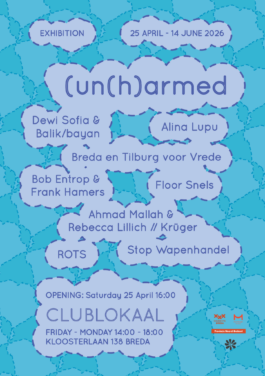
until 14 June
Opened Friday until Monday 14:00 - 18:00
Everywhere you look, you are confronted with the militarization of society. The government is urging people to stock up on emergency supplies, Mark Rutte, Secretary General of NATO, warned that we must “prepare for war as our grandparents experienced it.” Young people are encouraged to serve in the military, with Princess Amalia and Queen Maxima as shining examples. Shares in defense companies have been popular in recent years and have skyrocketed in value. Even the Sinterklaas news show is filled with stories about soldiers, emergency kits, and bombs.
Breda has long been a city associated with the military. The Royal Military Academy is housed in the castle in the city center. Recently, Breda was declared the “Defense City of the Netherlands”, a hub of the defense industry by (currently the biggest) political party D66. The building that houses Clublokaal was originally built as part of the former Chassé Barracks and served as a storage facility for weapons and medical supplies, among other things.
But how inevitable is this threat of war, really? How do we deal with the escalating rhetoric of war? Who benefits from the increasing militarization? How do we prepare ourselves as a society to take care of one another? What role do art and artists play in this seemingly inevitable development?
Upcoming Activities
Friday 15 May 2PM - 6PM
Making a Foxhole Radio with Floor Snels
Saturday 16 May 3PM - 5PM
Workshop Stop Arms Trade [general]
Friday 29 May 7:30PM - 10PM
Philosophical Café: How to re-enchant the world?
Saturday 30 May 3PM - 5PM
Workshop Stop Arms Trade [Brabant]
Monday 1 June 6PM - 9PM
Open Monday: Almanac Presentation and Peace Fries
Sunday 14 June
Closing Symposium with Platform BK
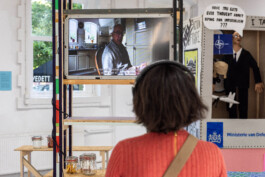
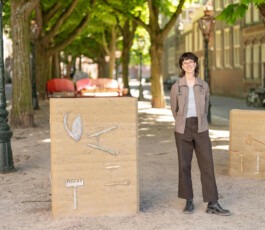
Participating artists and activists
FLOOR SNELS explores how power structures shape our environment and seeks ways to dismantle them as an artist and philosopher. Through her installations, she connects speculative imagination with critical reality.
…fourage… draws on the history of Kloosterlaan 138 as a storage facility for the Chassé Barracks, but reverses its logic. Instead of military supplies, there is collective equipment. Instead of ready-made products, there are skills that are passed from hand to hand. Through workshops, gatherings, and conversations, the installation is expanded with the knowledge of visitors, local residents, and co-creators.


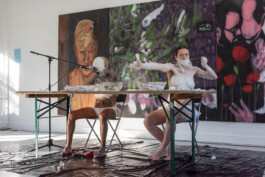
AHMAD MALLAH & REBECCA LILLICH // KRÜGER are an Amsterdam-based performance duo who interweave the personal and the political and use open symbols to encourage reflection, introspection, and connection.
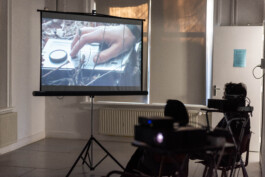
During the opening of (un(h)armed, they presented Yalla Tnam (2026), a performance that explores surrealism and hypernormativity through song, gestures, and costumes. A video recording of the performance is on view during the exhibition.

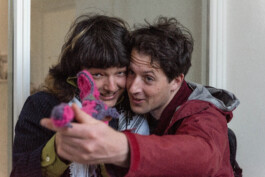
ROTS is a language artist researching with performances. For this exhibition they crocheted a gun that we will unravel together during the closing symposium on June 14th.
They also made a drawing together with Cor, who advocates for justice for disabled people.

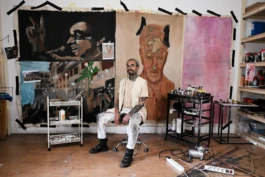
AHMAD MALLAH is a Palestinian artist who was born and raised in Syria. His art explores themes such as war, diaspora, identity, gender, and the body.
During (un(h)armed, Mallah’s paintings from the series I wish everything was different (2025) are on view, in which he explores the weight of human suffering and the fragility of existence.
Photo: Ahmad Mallah’s website

BREDA EN TILBURG VOOR VREDE is a group of people from the Breda and Tilburg area who oppose militarization and the promotion of war. They resist the systems of inequality and oppression that are the root causes of the wars we see around us today. They organize actions and hold meetings to inform people about local developments and the broader context surrounding this issue.
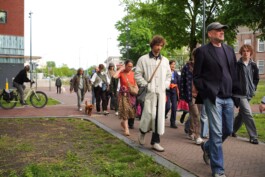
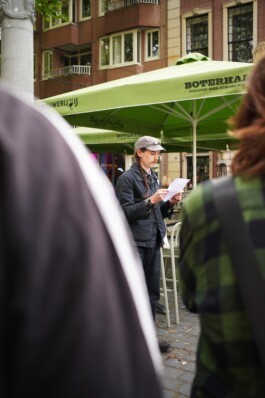
During (un(h)armed), they organized a critical freedom walk on May 5 (Liberation Day). Along the route through Breda, they paused, literally and figuratively, to reflect on what freedom and peace actually mean today, since the “liberation” from fascism in World War II. How free are we really, and what does the slogan “never again” mean in this era of pervasive fascism?
In addition, they invited Stop Wapenhandel to give two workshops.


BALIK/BAYAN is a group for the Filipino diaspora in the Netherlands that advocates for migrants, human rights, environmental justice, and international solidarity. They do this through various means, including organizing meetings, actions, and demonstrations. Effigies play an important role in these gatherings; papier-mâché sculptures carried during demonstrations.
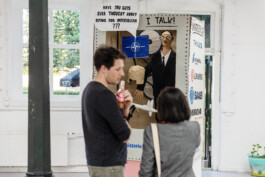
During (un(h)armed, they bring the practice of effigy-making to Clublokaal. They lead various workshops during which an effigy was made collaboratively. This effigy will be displayed during the exhibition and ultimately destroyed during the closing symposium on June 14th.

STOP WAPENHANDEL is an independent research and advocacy group that advocates for sustainable security, not based on military power and deterrence, but on resolving the root causes of conflict.
During (un(h)armed, Stop Wapenhandel organizes two workshops:
Saturday, May 16 | 3PM - 5PM
Workshop on the arms trade and armament in general.
Saturday, May 30 | 3PM - 5PM
Workshop on militarization and the military industry in Brabant.
The workshops will cover:
* How the rules and regulations regarding the arms trade are interpreted and undermined;
* Where Dutch and European weapons are sent and who the most controversial customers are;
* What the most important companies in the arms industry are and what they produce. Which companies are located in Brabant? How are they supported by the government?
* The (economic, foreign, and military) policies behind the arms trade.
The workshops can also be attended separately.

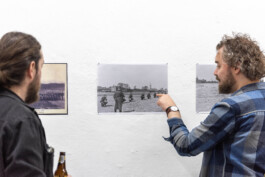
ALINA LUPU is a post-conceptual artist, writer, photographer, and activist. She focuses on protest and solidarity and the role that the creation of images—both online and offline—plays in this. She observes, documents, and supports collectives and individuals who are confronted with precarity and who come together to dismantle capitalist, business-as-usual systems of exploitation. She then reactivates the power and presence of protest beyond its own boundaries.
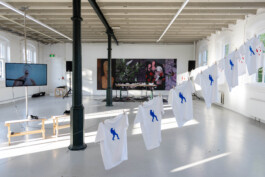
During (un(h)armed, she dives into the archive of anti-war and anti-imperialist posters. The clothing she prints with the images will be distributed by the end of the exhibition.


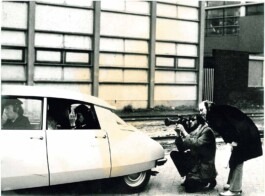
BOB ENTROP AND FRANK HAMERS were co-founders of De Kritiese Filmers in the 1970s, the first film collective in the Netherlands. Dissatisfied with the academy’s curriculum, which focused solely on art and aesthetics, they directed their collective’s efforts toward content: society, politics, and current events. The goal of their films: to spark social debate and thereby unleash a revolution. As a collective, they had no hierarchy; everyone was equal.
At the time, they made the films “Netherlands out of NATO” and “Soldier's Handbook”. Both can be viewed during (un(h)armed.
Photo on the left: De Kritiese Filmers archive


Accessibility
Admission to the exhibition and activities is free. Donations are appreciated and can be made by debit card at the bar.
The exhibition is on display on both floors of Clublokaal. Open Mondays and workshops take place on the ground floor. Unfortunately, there is not (yet) a wheelchair-accessible restroom or elevator in the building.
There is a paid parking lot directly across from the building. Clublokaal is also easily accessible on foot: it is about a 10-minute walk from Breda Station.
Both Dutch and English are spoken during the workshops and activities.
Do you have specific questions about accessibility, or other questions regarding the lecture? Please feel free to contact us at: info@lokaal.club.
Clublokaal is supported by the Municipality of Breda, the Province of North Brabant, Mondriaan Fund and the KLEIO Foundation.

until 14 June
Opened Friday until Monday 14:00 - 18:00
Everywhere you look, you are confronted with the militarization of society. The government is urging people to stock up on emergency supplies, Mark Rutte, Secretary General of NATO, warned that we must “prepare for war as our grandparents experienced it.” Young people are encouraged to serve in the military, with Princess Amalia and Queen Maxima as shining examples. Shares in defense companies have been popular in recent years and have skyrocketed in value. Even the Sinterklaas news show is filled with stories about soldiers, emergency kits, and bombs.
Breda has long been a city associated with the military. The Royal Military Academy is housed in the castle in the city center. Recently, Breda was declared the “Defense City of the Netherlands”, a hub of the defense industry by (currently the biggest) political party D66. The building that houses Clublokaal was originally built as part of the former Chassé Barracks and served as a storage facility for weapons and medical supplies, among other things.
But how inevitable is this threat of war, really? How do we deal with the escalating rhetoric of war? Who benefits from the increasing militarization? How do we prepare ourselves as a society to take care of one another? What role do art and artists play in this seemingly inevitable development?
Upcoming Activities
Friday 15 May 2PM - 6PM
Making a Foxhole Radio with Floor Snels
Saturday 16 May 3PM - 5PM
Workshop Stop Arms Trade [general]
Friday 29 May 7:30PM - 10PM
Philosophical Café: How to re-enchant the world?
Saturday 30 May 3PM - 5PM
Workshop Stop Arms Trade [Brabant]
Monday 1 June 6PM - 9PM
Open Monday: Almanac Presentation and Peace Fries
Sunday 14 June
Closing Symposium with Platform BK
Participating artists and activists
FLOOR SNELS explores how power structures shape our environment and seeks ways to dismantle them as an artist and philosopher. Through her installations, she connects speculative imagination with critical reality.
…fourage… draws on the history of Kloosterlaan 138 as a storage facility for the Chassé Barracks, but reverses its logic. Instead of military supplies, there is collective equipment. Instead of ready-made products, there are skills that are passed from hand to hand. Through workshops, gatherings, and conversations, the installation is expanded with the knowledge of visitors, local residents, and co-creators.


AHMAD MALLAH & REBECCA LILLICH // KRÜGER are an Amsterdam-based performance duo who interweave the personal and the political and use open symbols to encourage reflection, introspection, and connection.
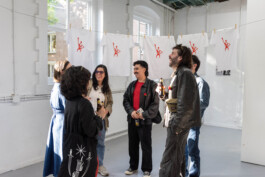
During the opening of (un(h)armed, they presented Yalla Tnam (2026), a performance that explores surrealism and hypernormativity through song, gestures, and costumes. A video recording of the performance is on view during the exhibition.

ROTS is a language artist researching with performances. For this exhibition they crocheted a gun that we will unravel together during the closing symposium on June 14th.
They also made a drawing together with Cor, who advocates for justice for disabled people.

AHMAD MALLAH is a Palestinian artist who was born and raised in Syria. His art explores themes such as war, diaspora, identity, gender, and the body.
During (un(h)armed, Mallah’s paintings from the series I wish everything was different (2025) are on view, in which he explores the weight of human suffering and the fragility of existence.
Photo: Ahmad Mallah’s website

BREDA EN TILBURG VOOR VREDE is a group of people from the Breda and Tilburg area who oppose militarization and the promotion of war. They resist the systems of inequality and oppression that are the root causes of the wars we see around us today. They organize actions and hold meetings to inform people about local developments and the broader context surrounding this issue.
During (un(h)armed), they organized a critical freedom walk on May 5 (Liberation Day). Along the route through Breda, they paused, literally and figuratively, to reflect on what freedom and peace actually mean today, since the “liberation” from fascism in World War II. How free are we really, and what does the slogan “never again” mean in this era of pervasive fascism?
In addition, they invited Stop Wapenhandel to give two workshops.


BALIK/BAYAN is a group for the Filipino diaspora in the Netherlands that advocates for migrants, human rights, environmental justice, and international solidarity. They do this through various means, including organizing meetings, actions, and demonstrations. Effigies play an important role in these gatherings; papier-mâché sculptures carried during demonstrations.
During (un(h)armed, they bring the practice of effigy-making to Clublokaal. They lead various workshops during which an effigy was made collaboratively. This effigy will be displayed during the exhibition and ultimately destroyed during the closing symposium on June 14th.

STOP WAPENHANDEL is an independent research and advocacy group that advocates for sustainable security, not based on military power and deterrence, but on resolving the root causes of conflict.
During (un(h)armed, Stop Wapenhandel organizes two workshops:
Saturday, May 16 | 3PM - 5PM
Workshop on the arms trade and armament in general.
Saturday, May 30 | 3PM - 5PM
Workshop on militarization and the military industry in Brabant.
The workshops will cover:
* How the rules and regulations regarding the arms trade are interpreted and undermined;
* Where Dutch and European weapons are sent and who the most controversial customers are;
* What the most important companies in the arms industry are and what they produce. Which companies are located in Brabant? How are they supported by the government?
* The (economic, foreign, and military) policies behind the arms trade.
The workshops can also be attended separately.

ALINA LUPU is a post-conceptual artist, writer, photographer, and activist. She focuses on protest and solidarity and the role that the creation of images—both online and offline—plays in this. She observes, documents, and supports collectives and individuals who are confronted with precarity and who come together to dismantle capitalist, business-as-usual systems of exploitation. She then reactivates the power and presence of protest beyond its own boundaries.
During (un(h)armed, she dives into the archive of anti-war and anti-imperialist posters. The clothing she prints with the images will be distributed by the end of the exhibition.


BOB ENTROP AND FRANK HAMERS were co-founders of De Kritiese Filmers in the 1970s, the first film collective in the Netherlands. Dissatisfied with the academy’s curriculum, which focused solely on art and aesthetics, they directed their collective’s efforts toward content: society, politics, and current events. The goal of their films: to spark social debate and thereby unleash a revolution. As a collective, they had no hierarchy; everyone was equal.
At the time, they made the films “Netherlands out of NATO” and “Soldier's Handbook”. Both can be viewed during (un(h)armed.
Photo on the left: De Kritiese Filmers archive


Accessibility
Admission to the exhibition and activities is free. Donations are appreciated and can be made by debit card at the bar.
The exhibition is on display on both floors of Clublokaal. Open Mondays and workshops take place on the ground floor. Unfortunately, there is not (yet) a wheelchair-accessible restroom or elevator in the building.
There is a paid parking lot directly across from the building. Clublokaal is also easily accessible on foot: it is about a 10-minute walk from Breda Station.
Both Dutch and English are spoken during the workshops and activities.
Do you have specific questions about accessibility, or other questions regarding the lecture? Please feel free to contact us at: info@lokaal.club.
Clublokaal is supported by the Municipality of Breda, the Province of North Brabant, Mondriaan Fund and the KLEIO Foundation.

Kloosterlaan 138
4811 EE Breda
kloosterlaan138 [at] gmail [dot] com
Sign up for the newsletter
Instagram
Pictures by Hussel Zhu
Illustrations by Ester Venema