
March 7-29, 2026
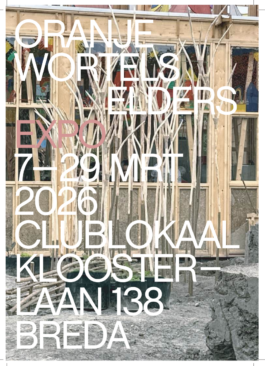
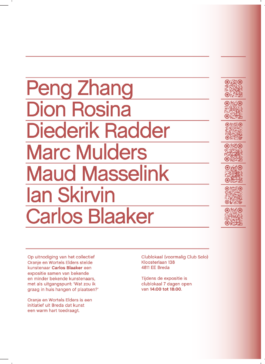
At the invitation of the Oranje en Wortels elders collective, artist Carlos Blaaker curated an exhibition of well-known and lesser-known artists, based on the premise “what would I like to hang or place in my home.” Oranje Wortels Elders is an initiative from Breda that supports the arts.
The exhibition can be visited every day from 2:00 p.m. to 6:00 p.m. at Clublokaal.
Ian Skirvin
Ian Skirvin's (1991) practice focuses on finding and assembling materials, with weathering, the beauty of decay, and the revelation of the hidden playing a central role. These elements come together in space-filling installations in which the visitor takes on the role of performer. This creates an improvised setting in which chance takes the lead. His field of work encompasses a wide range of media, including 3D printing, ceramics, sculptural assembly, painting, and sound. Around these elements, a world emerges which, with the help of scenographic elements, evokes a ‘suspension of disbelief’, a reality in which the grotesque goes hand in hand with a humorous twist. Sometimes the work manifests itself as a fully constructed set including sound composition, at other times it consists solely of an improvised performance. What is most important to Skirvin is creating a work that takes shape as an experience, a perception that plays out in the mind of the viewer.
Diederik Radder
If this is what you want
The hand-formed ceramic vases represent the convergence of Diederik Radder's two professions: that of artist and that of judge. He uses key concepts from jurisprudence, such as guilt, evidence, and truth, and combines them with symbols of death. In doing so, he places his works in the tradition of vanitas art, reminding the viewer of the finiteness of life and the emptiness of worldly ambitions. Whereas classical vanitas still lifes referred to death in order to evoke spiritual reflection, these ceramic objects depict a secular variant of transience: the fragility of human laws and the vulnerability of moral awareness. The combination of ceramics—a medium that embodies both durability and fragility—with symbols of law and death creates a tension that prompts the viewer to ask: what does justice mean in our current world, and how does our human vulnerability relate to systems that claim to be objective and timeless? The message may be serious, but the story is told with humor. The skulls seem to be mocking the viewer. By juxtaposing humor and seriousness, Radder invites us to take a different look at the law—not as a system, but as a human practice.
Marc Mulders
Marc Mulders is a Dutch painter, watercolorist, photographer, and glass artist.
Dion Rosina
Dion Rosina (1991) is a Dutch Afro-Caribbean painter. His work often begins with collages that he compiles from a variety of found images, which he then edits and rearranges in his paintings, a working process that is strongly influenced by the sampling culture of hip-hop music. Rather than focusing on a single image, Rosina is more interested in how different themes, ideas, and images can influence each other through the act of assembling. This reflects life itself, in which everything is interconnected and constantly shaped by interaction. This approach ties in with his broader interest in how meaning can arise through symbiotic relationships between different fragments. Rosina is influenced by themes such as spirituality, existence, alternative histories, and visual culture. His paintings move between abstraction and figuration, using a variety of techniques to create atmospheric, layered, and cryptic compositions that typically contain a human presence and invite deeper contemplation. Rosina began his artistic practice in 2020. Since then, his work has been exhibited at institutions such as Museum MORE, Museum Rembrandthuis, Drents Museum, and Museum Catharijneconvent, as well as at Alice Amati Gallery in London, Documenta Fifteen in Kassel, Art Brussels (represented by GoMulan Gallery), Stevenson Gallery in Amsterdam, and more. He has been nominated for the Royal Prize for Free Painting (2022, 2023, 2024) and the Volkskrant Visual Arts Prize (2024). In the same year, he participated in the Bed Stuy art residency.
Peng Zhang
Peng Zhang (1990) works and lives in Amsterdam. He is a Chinese artist, working on land projects, sculptures, paintings and drawings. Zhang’s fascination with art is inspired by rural life in Shijian Cun, the village where he was born in southern China, and his current life in the Netherlands. He created the land projects 72m2 Land and Paradise Garden. Serials. He also participated as the first resident of Grasland Ezinge in Groningen. Zhang constructs rural worlds by visualizing the poetic and harmonious moments of daily life in his paintings and drawings. He was a resident of Rijksacademie van beeldende kunsten from 2021 to 2023. He also studied for his MFA at AKV/St. Joost School for Art and Design Academy in Den Bosch.
Maud Masselink
Maud Masselink has a passion for drawing people. She mainly uses charcoal and sometimes mixed techniques to explore human strength and vulnerability, human relationships, and the relationship with the outside world. Although the distinction between drawing and painting sometimes blurs due to the way she uses and combines her materials, she prefers to work with charcoal because of the pure simplicity of the material. Maud's work is figurative and she strives for expression rather than photorealism. The lines are powerful without idealizing the image. People with piercing gazes and tousled hair. Alienating or nostalgic elements such as masks and vintage toys increasingly find their way onto the paper. In her studio, she surrounds herself with vintage toys, sewing patterns, and printing letters.
Carlos Blaaker
Carlos Blaaker is a sculptor and painter who works in a contemporary narrative style. Contemporary narrative art. Carlos moved to the Netherlands in 2024 from Curacao (where he had moved to in 2009 from Rotterdam). "I want to bring painting and sculpture closer together, so that a painting could also become a three-dimensional object and vice versa. Blaaker wants to tell a story with his art and often depicts ordinary people who live in his neighborhood. Blaaker's muses are the people in his neighborhood whom he sees around him every day: people from the LGBTIQ+ community, immigrants, homeless people. Recognizable types that you could encounter on the streets anywhere in the world. At first glance, the models appear to be depicted literally, but beneath the realistic surface of style lies a story created by the context in which they are placed. This transcends literalness and gives the works a certain layering from which they derive their meaning. However, the interpretation of the artwork is up to the viewer. “I am a storyteller in my work,” explains the artist. Through his art, Blaaker makes the ‘invisible’ members of society visible. He does not shy away from criticizing society in the process.
March 7-29, 2026
At the invitation of the Oranje en Wortels elders collective, artist Carlos Blaaker curated an exhibition of well-known and lesser-known artists, based on the premise “what would I like to hang or place in my home.” Oranje Wortels Elders is an initiative from Breda that supports the arts.
The exhibition can be visited every day from 2:00 p.m. to 6:00 p.m. at Clublokaal.
Ian Skirvin
Ian Skirvin's (1991) practice focuses on finding and assembling materials, with weathering, the beauty of decay, and the revelation of the hidden playing a central role. These elements come together in space-filling installations in which the visitor takes on the role of performer. This creates an improvised setting in which chance takes the lead. His field of work encompasses a wide range of media, including 3D printing, ceramics, sculptural assembly, painting, and sound. Around these elements, a world emerges which, with the help of scenographic elements, evokes a ‘suspension of disbelief’, a reality in which the grotesque goes hand in hand with a humorous twist. Sometimes the work manifests itself as a fully constructed set including sound composition, at other times it consists solely of an improvised performance. What is most important to Skirvin is creating a work that takes shape as an experience, a perception that plays out in the mind of the viewer.
Diederik Radder
If this is what you want
The hand-formed ceramic vases represent the convergence of Diederik Radder's two professions: that of artist and that of judge. He uses key concepts from jurisprudence, such as guilt, evidence, and truth, and combines them with symbols of death. In doing so, he places his works in the tradition of vanitas art, reminding the viewer of the finiteness of life and the emptiness of worldly ambitions. Whereas classical vanitas still lifes referred to death in order to evoke spiritual reflection, these ceramic objects depict a secular variant of transience: the fragility of human laws and the vulnerability of moral awareness. The combination of ceramics—a medium that embodies both durability and fragility—with symbols of law and death creates a tension that prompts the viewer to ask: what does justice mean in our current world, and how does our human vulnerability relate to systems that claim to be objective and timeless? The message may be serious, but the story is told with humor. The skulls seem to be mocking the viewer. By juxtaposing humor and seriousness, Radder invites us to take a different look at the law—not as a system, but as a human practice.
Marc Mulders
Marc Mulders is a Dutch painter, watercolorist, photographer, and glass artist.
Dion Rosina
Dion Rosina (1991) is a Dutch Afro-Caribbean painter. His work often begins with collages that he compiles from a variety of found images, which he then edits and rearranges in his paintings, a working process that is strongly influenced by the sampling culture of hip-hop music. Rather than focusing on a single image, Rosina is more interested in how different themes, ideas, and images can influence each other through the act of assembling. This reflects life itself, in which everything is interconnected and constantly shaped by interaction. This approach ties in with his broader interest in how meaning can arise through symbiotic relationships between different fragments. Rosina is influenced by themes such as spirituality, existence, alternative histories, and visual culture. His paintings move between abstraction and figuration, using a variety of techniques to create atmospheric, layered, and cryptic compositions that typically contain a human presence and invite deeper contemplation. Rosina began his artistic practice in 2020. Since then, his work has been exhibited at institutions such as Museum MORE, Museum Rembrandthuis, Drents Museum, and Museum Catharijneconvent, as well as at Alice Amati Gallery in London, Documenta Fifteen in Kassel, Art Brussels (represented by GoMulan Gallery), Stevenson Gallery in Amsterdam, and more. He has been nominated for the Royal Prize for Free Painting (2022, 2023, 2024) and the Volkskrant Visual Arts Prize (2024). In the same year, he participated in the Bed Stuy art residency.
Peng Zhang
Peng Zhang (1990) works and lives in Amsterdam. He is a Chinese artist, working on land projects, sculptures, paintings and drawings. Zhang’s fascination with art is inspired by rural life in Shijian Cun, the village where he was born in southern China, and his current life in the Netherlands. He created the land projects 72m2 Land and Paradise Garden. Serials. He also participated as the first resident of Grasland Ezinge in Groningen. Zhang constructs rural worlds by visualizing the poetic and harmonious moments of daily life in his paintings and drawings. He was a resident of Rijksacademie van beeldende kunsten from 2021 to 2023. He also studied for his MFA at AKV/St. Joost School for Art and Design Academy in Den Bosch.
Maud Masselink
Maud Masselink has a passion for drawing people. She mainly uses charcoal and sometimes mixed techniques to explore human strength and vulnerability, human relationships, and the relationship with the outside world. Although the distinction between drawing and painting sometimes blurs due to the way she uses and combines her materials, she prefers to work with charcoal because of the pure simplicity of the material. Maud's work is figurative and she strives for expression rather than photorealism. The lines are powerful without idealizing the image. People with piercing gazes and tousled hair. Alienating or nostalgic elements such as masks and vintage toys increasingly find their way onto the paper. In her studio, she surrounds herself with vintage toys, sewing patterns, and printing letters.
Carlos Blaaker
Carlos Blaaker is a sculptor and painter who works in a contemporary narrative style. Contemporary narrative art. Carlos moved to the Netherlands in 2024 from Curacao (where he had moved to in 2009 from Rotterdam). "I want to bring painting and sculpture closer together, so that a painting could also become a three-dimensional object and vice versa. Blaaker wants to tell a story with his art and often depicts ordinary people who live in his neighborhood. Blaaker's muses are the people in his neighborhood whom he sees around him every day: people from the LGBTIQ+ community, immigrants, homeless people. Recognizable types that you could encounter on the streets anywhere in the world. At first glance, the models appear to be depicted literally, but beneath the realistic surface of style lies a story created by the context in which they are placed. This transcends literalness and gives the works a certain layering from which they derive their meaning. However, the interpretation of the artwork is up to the viewer. “I am a storyteller in my work,” explains the artist. Through his art, Blaaker makes the ‘invisible’ members of society visible. He does not shy away from criticizing society in the process.
Kloosterlaan 138
4811 EE Breda
kloosterlaan138 [at] gmail [dot] com
Sign up for the newsletter
Instagram
Pictures by Hussel Zhu
Illustrations by Ester Venema